
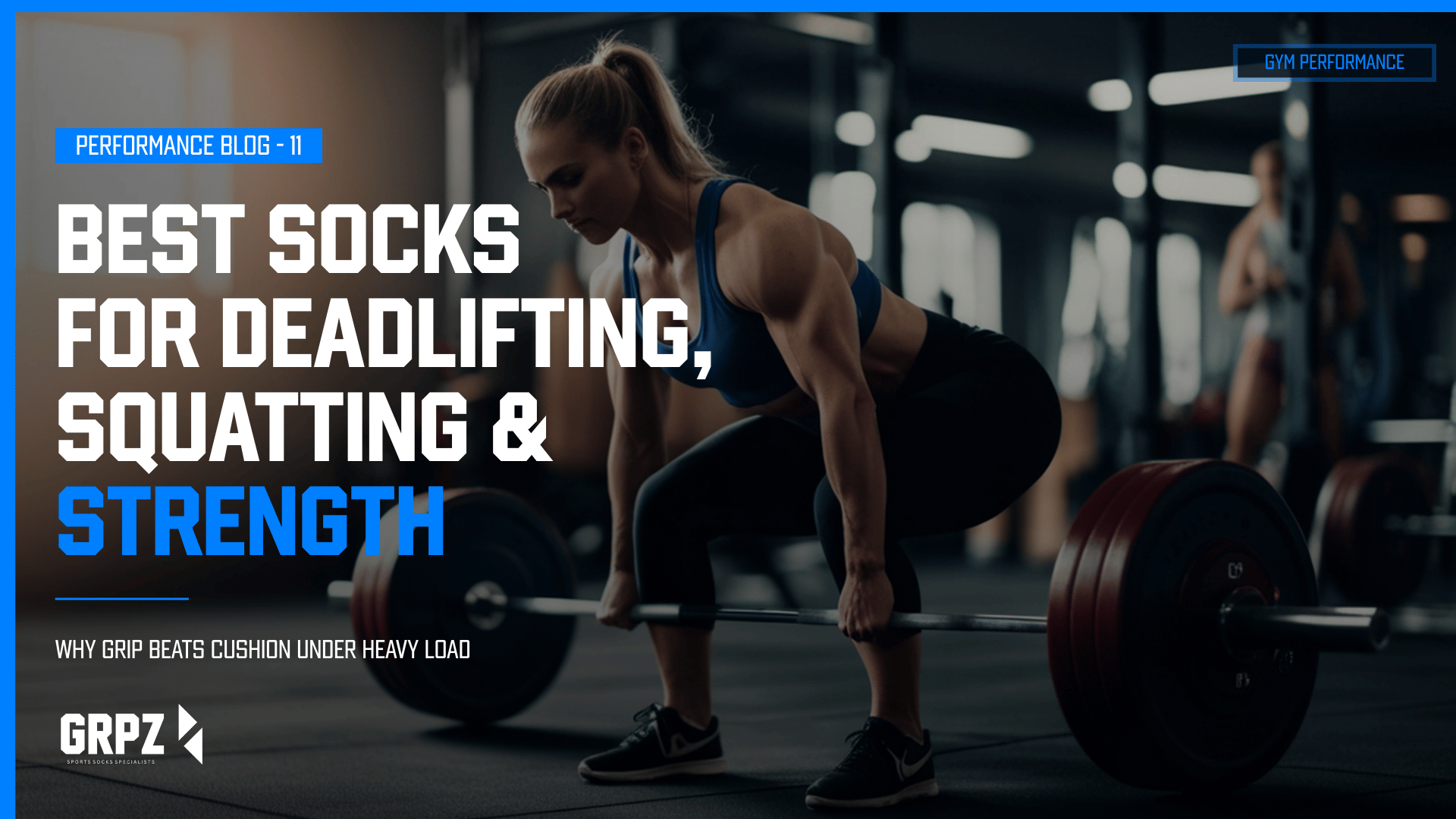
Best Socks for Deadlifting, Squatting & Strength Training
Most lifters spend serious money on their shoes.
They research heel drop, sole stiffness, ankle support. They know exactly why their lifting shoes matter.
And then they put on whatever socks were at the top of the drawer.
Why socks matter in strength training
Your shoe controls the external interface between your foot and the floor. Your sock controls the internal interface between your foot and your shoe.
If your foot is moving inside your shoe, the stability your shoe provides is being undermined before the force even transfers to the ground.
It's like building on a solid foundation with loose bricks.
Deadlifting and ground contact
The deadlift is a pure force transfer movement. You load the bar, you push the ground away.
Everything about that movement benefits from a direct, stable connection to the floor. Flat sole shoes. Minimal heel drop. Maximum ground feel.
The sock is part of that chain. A sock that allows internal movement adds a layer of instability that the nervous system has to process during the pull.
Under moderate weight, you compensate. Under maximum effort, you can't afford to.
Squatting and stability under load
The squat demands stability at every point in the movement. Especially the bottom.
That's where the load is highest, the leverages are most compromised, and the nervous system is working hardest to keep everything aligned.
If your foot position is uncertain at the bottom of a squat.... even slightly, your knees track less reliably, your hips shift to compensate, and the movement becomes less efficient.
Grip socks don't fix technique. But they remove one variable that makes technique harder to express.
Grip vs cushion in the gym
Cushioning makes socks comfortable. It doesn't make you stable.
In fact, too much cushioning under the foot reduces proprioception - your ability to feel exactly how your foot is loaded. For strength training, that sensory feedback matters.
You want to feel the ground. You want to know where your weight is across the sole. Excessive cushioning blunts that signal.
Grip keeps your foot in place. That's the priority for strength work.
What to look for
For deadlifts and squats specifically, midfoot compression and heel stability are the key factors. The foot shouldn't move inside the shoe during the setup or the lift.
For higher-volume work - circuits, conditioning, hybrid sessions - you also want a construction that holds its shape across the whole session. A sock that stretches and bags out by the end of the first hour isn't doing its job in the second.
→ GRPZ Workout PRO — designed for the stability demands of the gym, from heavy lifting to hybrid training.Shop at grpzsports.com |
The bottom line
Strength training is built on precision. Every small variable that introduces uncertainty to the movement is a variable worth eliminating.
Foot stability under load is one of the simplest to address. And one of the most consistently overlooked.
| FEATURE |
STANDARD SOCKS |
GRIP SOCKS |
|
Force transfer in deadlift |
Reduced by internal movement |
Direct with stable foot position |
|
Squat depth stability |
Variable with loose socks |
More consistent with locked midfoot |
|
Proprioception |
Reduced by excess cushioning |
Maintained with minimal, grippy construction |
|
Session endurance |
Sock shape degrades over time |
Consistent fit across full session |
FAQs
Q — Do socks matter for deadlifts?
Yes. Internal foot movement inside the shoe reduces the directness of force transfer during the pull. Stability matters even in static lifts.
Q — Are lifting shoes better than grip socks?
They serve different functions. Lifting shoes provide an elevated heel for squats. Grip socks improve the connection between foot and shoe interior. Many serious lifters use both.
Q — Should I squat in flat shoes or elevated heels?
That depends on your mobility and technique. Regardless of shoe choice, internal foot stability is always beneficial.
Q — Can I wear grip socks in regular trainers?
Yes. Grip socks improve stability regardless of shoe type. You don't need specialist footwear for them to make a difference.
Q — Does cushioning help or hurt in strength training?
Too much cushioning reduces ground feel and proprioception. For heavy lifting, less is more. Stability and ground contact matter more than comfort.
Q — Which GRPZ socks are best for the gym?
GRPZ Workout PRO socks are built for gym training — from heavy compound lifts to high-volume hybrid sessions.