
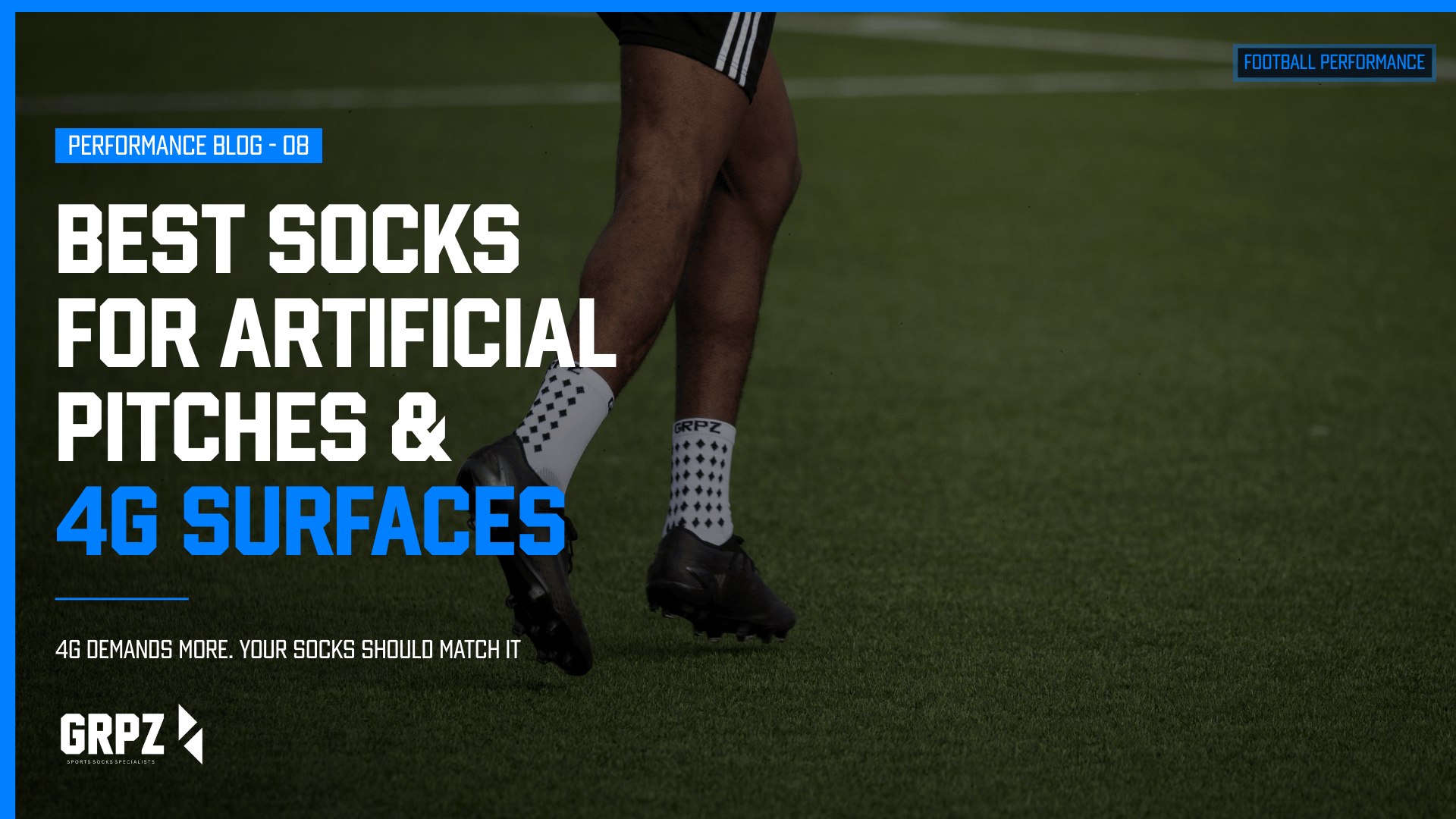
Best Socks for Artificial Pitches & 4G Surfaces
4G changed football training. Not always for the better.
The surface is harder. The friction is higher. The impact on the body per session is measurably different from grass.
Most players adjusted their boots when 4G became standard. Very few adjusted their socks. That's the gap.
What makes 4G different
Artificial pitches use rubber infill and synthetic fibres that generate significantly more surface friction than natural grass.
That higher friction means faster direction changes and a more consistent surface in all weather conditions. It also means more load through every foot contact, more heat generated between boot and surface, and more demand on everything between your foot and the ground.
Your sock sits right in the middle of that equation.
Why standard socks fall short on artificial surfaces
Standard socks were designed for grass. Lower friction, softer surface, less repetitive impact.
On 4G, the increased surface friction amplifies every small movement inside the boot. Your foot shifts, the friction catches it differently than it would on grass, and the net result is more instability, more blister risk, and more fatigue across a session.
The surface is doing more work. Your sock needs to match that.
What to look for in socks for artificial pitches
The priorities change slightly on 4G compared to grass.
You need reliable grip at the midfoot to prevent internal sliding during direction changes. You need a construction that manages heat and moisture because 4G sessions tend to run hotter than grass. And you need durability — artificial fibres are abrasive and low-quality socks degrade quickly.
Cushioning matters less than stability. A thin, well-fitted grip sock outperforms a thick padded sock on most artificial surfaces.
The blister problem on 4G
Blisters are more common on artificial pitches for a simple reason. Higher surface friction means more force transfer through every contact. Any internal movement in the boot adds to that total friction load on the skin.
Players who rarely blister on grass often find 4G sessions create problems in the same boots. The boot hasn't changed. The demands of the surface have.
Reducing internal movement is the most direct way to reduce blister risk on artificial pitches.
Match day vs training on 4G
Training loads on artificial pitches are typically higher than match play. More repetitions, more direction changes, more accumulated impact.
The sock that performs well in a 90-minute match needs to perform equally well across two hours of training. That's where sock quality separates. The first 30 minutes tells you nothing. The last 30 minutes tells you everything.
→ GRPZ Performance PRO — engineered for the demands of modern football training, including artificial surfaces.Shop at grpzsports.com |
The bottom line
4G is a different surface. It demands more from every piece of kit in contact with it.
Most players upgrade their boots for artificial pitches. The sock is equally important and almost always overlooked.
Get the base right and the rest of the session follows.
FEATURE |
STANDARD SOCKS |
GRIP SOCKS |
|
Stability on 4G |
Variable with standard socks |
Consistent with grip socks |
|
Blister risk |
Higher due to surface friction |
Reduced by limiting internal movement |
|
Heat and fatigue |
Builds faster on artificial surfaces |
Better managed with proper construction |
|
Durability |
Standard socks degrade faster on artificial fibres |
Built to handle repeated artificial surface use |
FAQs
Q — Are grip socks better for 4G pitches?
Yes. The higher friction demands of artificial surfaces make internal foot stability more important, not less.
Q — Why do I get more blisters on 4G than grass?
Higher surface friction amplifies any internal movement in the boot. Reducing that movement directly reduces blister risk.
Q — Do I need different socks for 4G and grass?
Not necessarily different, but socks that perform on grass may not perform as well on artificial surfaces. Grip and durability matter more on 4G.
Q — Does surface friction affect fatigue?
Yes. Higher external friction means more force through every foot contact, which increases the load on your feet across a session.
Q — Should I wear grip socks for training or just matches on 4G?
Both. Training loads on artificial pitches are often higher than match play. The sock needs to perform across the full duration.
Q — Which GRPZ socks are best for artificial pitches?
GRPZ Performance PRO socks are designed for the demands of modern football training including regular use on artificial surfaces.