
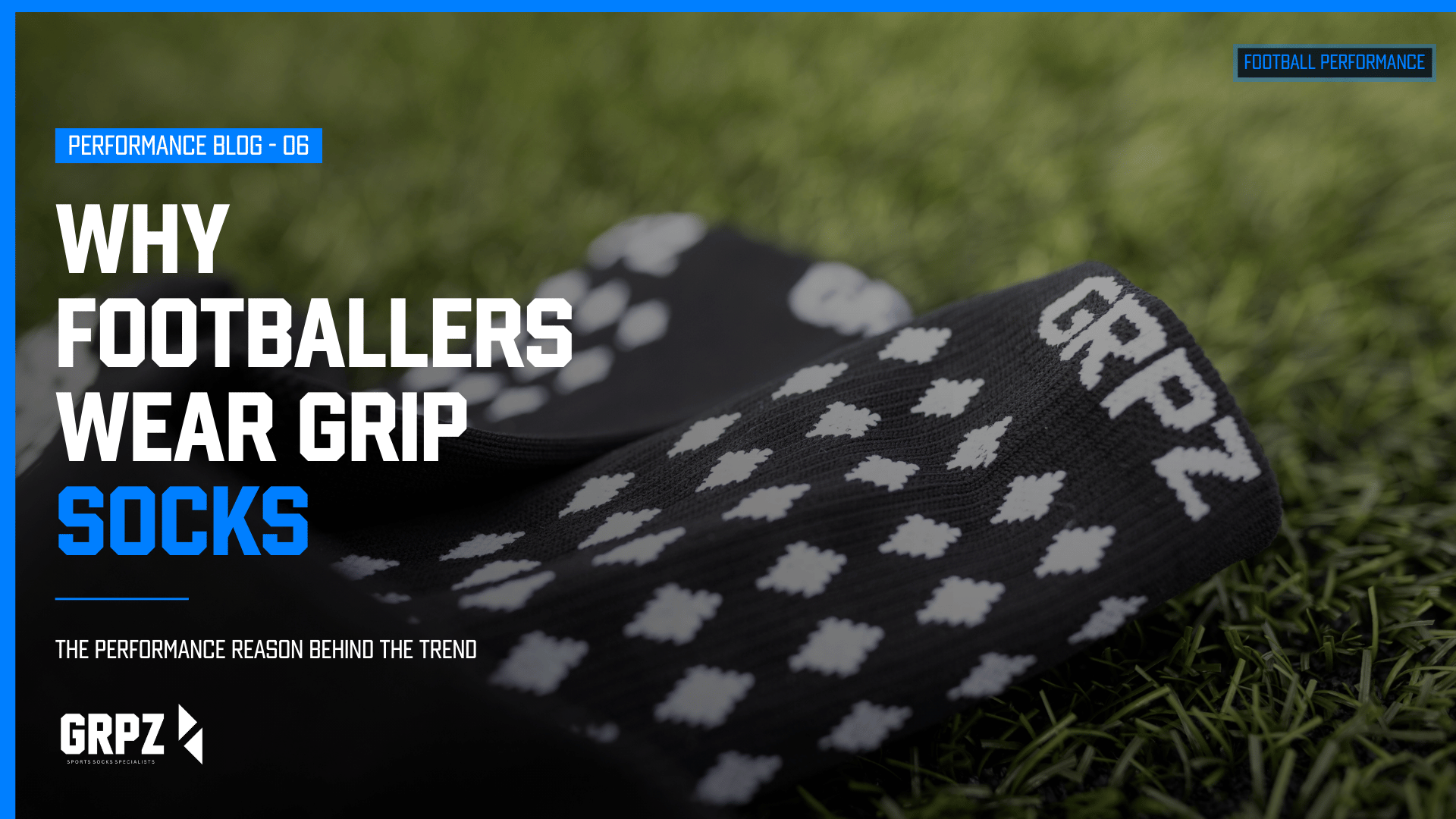
Why Footballers Wear Grip Socks
Look at almost any professional football match and you'll see it.
Players with tape around their ankles. Bits of sock cut away. A different layer underneath their team kit.
It looks odd if you don't know what it is. But once you understand why they do it… it makes complete sense.
It started at the top and worked its way down
Grip socks became visible at professional level first. Players started cutting the feet off their team socks and wearing grip socks underneath as a base layer.
The reason wasn't aesthetic. It was functional.
Inside a modern football boot, especially a tight, low-volume fit, your foot can still move. The boot holds. The sock doesn't always. And that small gap between foot and boot is where performance leaks out.
What grip socks actually do inside a boot
A football boot doesn't grip your foot. It grips the ground.
Your sock is the only thing between your foot and the inside of that boot. And if your sock is smooth, your foot moves. Not dramatically… but enough.
Grip socks add friction between the foot and the boot lining. That reduces internal movement. Which means when you plant, cut, or accelerate, your foot is already where it needs to be.
Not catching up. Already there.
Why it matters more than most players realise
Footballers change direction hundreds of times per session. Every time that happens, your foot loads, pushes, and resets.
If there's even small movement inside the boot during that sequence, your nervous system registers it. Your body adjusts. You hesitate, just slightly, because your base wasn't solid.
Under full fitness, you might not notice. Under fatigue, you absolutely will.
Why players cut their socks
Most team kits come with thick, standard socks that weren't designed for grip or fit.
Players found early that wearing grip socks underneath standard team socks made the boot too tight. The solution was to cut the feet off the team sock, wear the grip sock as the base layer, and tape the overlap.
It looks rough. It works perfectly.
That's why you see it from academy players all the way to international level. Function, not fashion.
What to look for in a football grip sock
Not all grip socks are the same.
For football specifically, you want a sock with a secure midfoot fit, full-coverage grip on the sole, and a construction that doesn't add bulk inside the boot.
Bulk is the enemy. A tight boot plus a thick sock equals compressed toes and reduced feel. The grip pattern needs to do its job without adding volume.
→ GRPZ Performance PRO — built for football training and match day stability.Shop at grpzsports.com |
The bottom line
Footballers wear grip socks because the alternative is accepting unnecessary instability inside their boots.
At professional level, no one leaves that to chance. At amateur and grassroots level, most players still haven't made the switch.
Once you train in them, it's hard to go back to not having that connection.
FEATURE |
STANDARD SOCKS |
GRIP SOCKS |
|
Foot stability in boot |
Variable |
Consistent |
|
Internal movement |
Higher, especially under fatigue |
Reduced significantly |
|
Blister risk |
Higher with standard team socks |
Often reduced |
|
Under fatigue |
Stability drops |
Holds better |
FAQs
Q — Why do footballers cut their socks?
To layer grip socks underneath without adding bulk. The grip sock goes on first, the team sock (with the foot cut off) covers the calf, and tape holds it in place.
Q — Do grip socks actually help in football boots?
Yes. They reduce internal movement between foot and boot lining, which improves stability during acceleration, cutting, and planting.
Q — Are grip socks used at professional level?
Widely. You'll see them at every level from academy football to international competition.
Q — Do grip socks work in tight-fitting boots?
Yes, as long as the sock isn't too thick. The grip pattern needs to function without adding significant bulk.
Q — Can I wear grip socks without cutting my team socks?
You can, but most players find the double-layer is too thick inside the boot. The cut-and-tape method is the most common approach.
Q — Which GRPZ socks are best for football?
GRPZ Performance PRO socks are designed specifically for football training and match day use.