
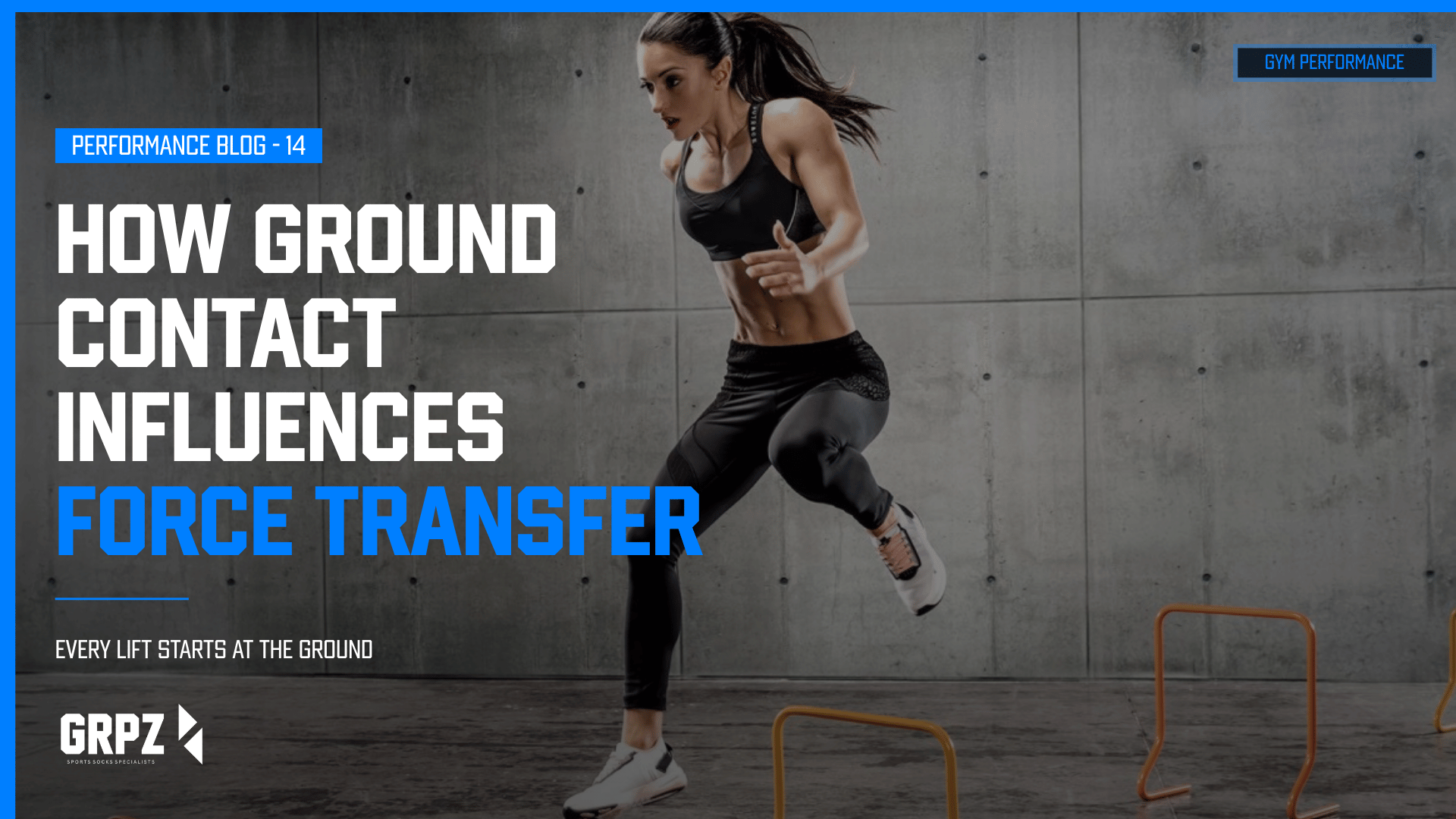
How Ground Contact Influences Force Transfer in Lifts
Every lift starts at the ground.
Not at your hands. Not at the bar. At your feet.
The force you generate travels upward through a chain that begins with the connection between your foot and the floor. If that connection isn't right, the chain is already broken before the bar moves.
The physics of force transfer
When you lift, you're applying force to the ground in order to move a load. The ground pushes back. That ground reaction force is what moves the bar.
For that transfer to be efficient, the contact between foot and ground needs to be as direct and stable as possible. Any material that absorbs, compresses, or allows movement between foot and floor reduces how much of that generated force actually reaches the bar.
Every unnecessary layer between foot and ground is a potential energy leak.
Why the foot-to-shoe interface matters
Your shoe provides the primary interface between foot and ground. But your sock controls what happens inside the shoe.
If your foot moves within the shoe during a heavy pull, the alignment you set up shifts. Not dramatically. But your nervous system registered the setup in one position and the lift begins in a slightly different one.
The adaptation your body makes to that difference is small. Multiplied across every rep of every session, it's significant.
Three-point contact in the squat
Experienced coaches often cue three-point foot contact in the squat — heel, ball of the foot, and base of the little toe all in contact with the ground simultaneously.
That three-point base distributes load evenly and creates maximum stability at the bottom of the movement.
If the foot is sliding inside the shoe, that three-point contact is inconsistent. The cue is correct. But the sock is preventing it from being expressed properly.
Deadlift specifics
Deadlifters who switch from cushioned trainers to flat-soled shoes typically feel more connected to the ground immediately.
What they're experiencing is better force transfer. Less compression between foot and floor. More direct ground contact.
The same principle applies inside the shoe. A foot that doesn't move during the setup and pull transfers force more efficiently than one that does.
The role of proprioception in heavy lifts
Your nervous system makes continuous adjustments throughout a heavy lift. It reads information from your feet — pressure, position, movement — and uses that to maintain balance and direct force output.
The more accurately it can read that information, the better those adjustments are.
Internal foot movement introduces noise into that signal. The nervous system is processing uncertainty rather than clarity. Under moderate load, it manages. Under maximal effort, it can't afford to.
The bottom line
Force transfer efficiency starts at the ground.
Every decision you make about footwear — shoe choice, sock choice, lacing — either improves or degrades that efficiency.
The athletes who lift most consistently are the ones who've built the chain properly from the ground up. Not just from the bar down.
FEATURE |
STANDARD SOCKS |
GRIP SOCKS |
|
Ground contact quality |
Compromised by internal movement |
Direct and consistent with grip sock |
|
Three-point contact expression |
Inconsistent if foot slides in shoe |
More reliably expressed |
|
Proprioceptive accuracy |
Reduced by instability and excess cushion |
Improved with stable foot position |
|
Force transfer efficiency |
Reduced by energy absorption and movement |
More direct from foot to ground |
FAQs
Q — Why does ground contact matter in lifting?
Because force transfer begins at the floor. Any instability or energy absorption between foot and ground reduces the efficiency of every lift.
Q — What is three-point foot contact?
A cue used in squatting to maintain contact between heel, ball of foot, and base of little toe simultaneously. It creates maximum stability at the base of the movement.
Q — Does internal foot movement actually affect lifts?
Yes. Even small movement introduces positional uncertainty that the nervous system has to process during the lift. Under maximal load, that cost matters.
Q — Why do experienced lifters prefer flat-soled shoes?
More direct ground contact improves force transfer and proprioception. The same logic applies to reducing unnecessary movement inside the shoe.
Q — Can a sock really make a difference to a heavy lift?
It can make the base more consistent. It doesn't add strength, but it removes variables that prevent existing strength from expressing reliably.
Q — Which GRPZ socks are built for heavy training?
GRPZ Workout PRO socks are designed for the stability and force transfer demands of serious gym training.